
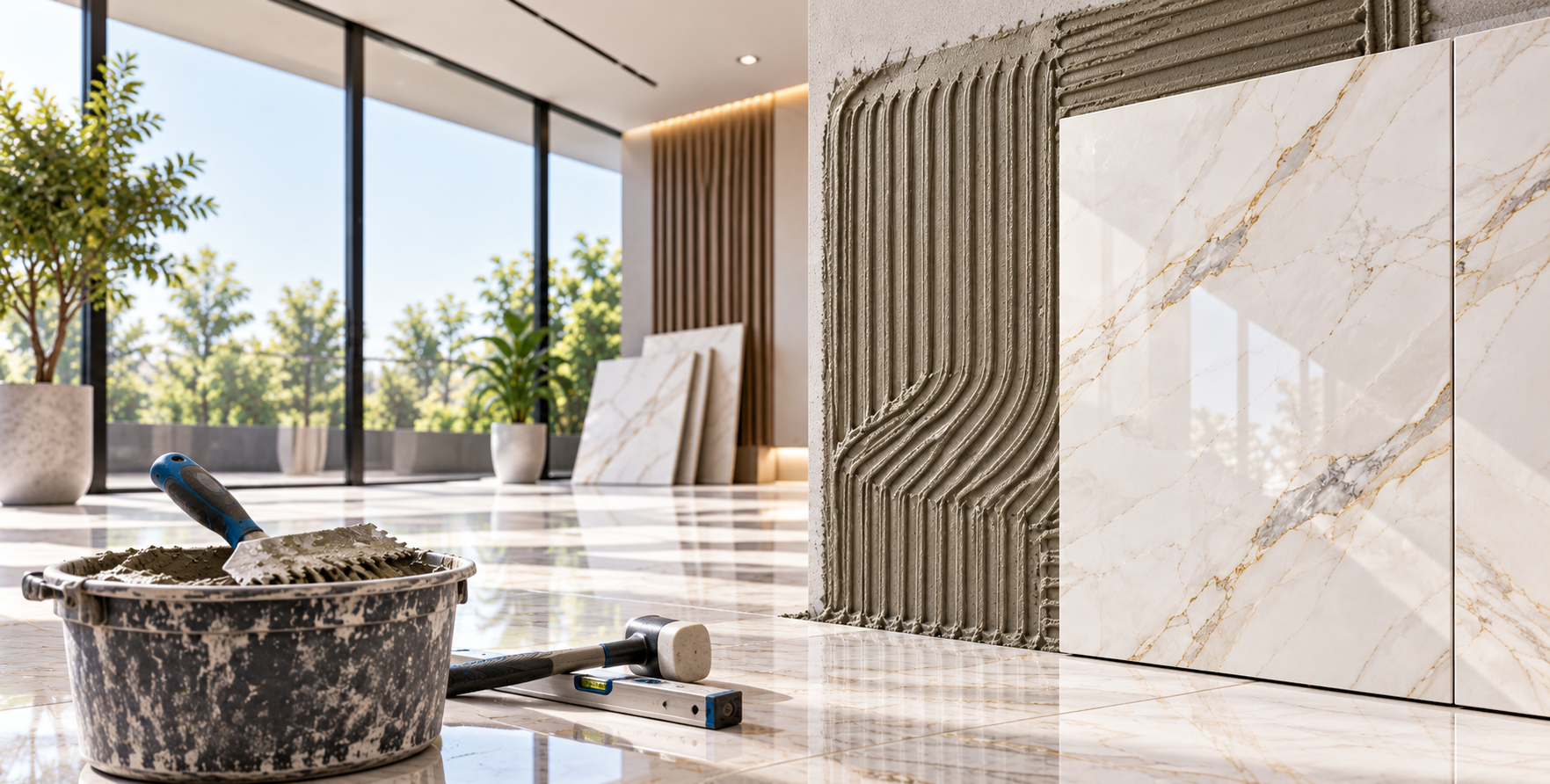
The Science of Bonding Strength: How to Choose the Right Epoxy for Industrial Flooring
The Anatomy of Industrial Adhesion
In industrial environments, a floor is not just a surface—it is a critical operational asset. Factories, warehouses, and commercial processing plants subject their flooring to relentless abuse, from the constant friction of heavy forklift traffic to severe chemical spills and extreme temperature fluctuations. Under these conditions, standard cementitious adhesives inevitably fail.
The structural integrity of heavy-duty tile or industrial flooring relies entirely on the science of its bonding agent. Epoxy adhesives and grouts provide the ultimate solution, engineered to deliver unparalleled shear strength and chemical resistance. However, selecting the right epoxy requires a deep understanding of structural demands and chemical formulations.
Mechanical vs. Chemical Bonding: How Epoxy Works
Unlike standard thin-set mortars that rely primarily on mechanical bonding (curing through the evaporation of water), epoxy is a two-part system consisting of a resin and a hardener. When these two components are mixed, an exothermic chemical reaction occurs, causing the polymers to cross-link.
This cross-linking creates a dense, thermosetting plastic that bonds both mechanically to the substrate's pores and chemically to the tile or flooring material. The result is a monolithic bond that is essentially waterproof and significantly stronger than the concrete substrate itself.
Critical Metrics for Selecting Industrial Epoxy
Not all epoxies are formulated equally. When specifying adhesives for high-stress commercial and industrial projects, structural engineers and contractors must evaluate several key performance metrics:
- Compressive and Shear Strength:Industrial floors must withstand immense point loads from heavy machinery and dynamic loads from moving vehicles. High-grade epoxies are formulated to absorb and distribute these stresses without fracturing or delaminating from the substrate.
- Chemical Resistance:In food processing, pharmaceutical, or manufacturing facilities, floors are frequently exposed to harsh acids, alkalis, and industrial solvents. Specialized epoxy formulations create a non-porous, chemically inert barrier that prevents these substances from degrading the bond or penetrating the concrete slab.
- Thermal Shock Resistance:Facilities that utilize steam cleaning or operate cold storage units subject their floors to rapid, extreme temperature changes. Standard adhesives will expand and contract at different rates than the tile, leading to "pop-ups." Thermal-shock-resistant epoxies retain a micro-level of flexibility to absorb these temperature differentials.
- Curing Time (Pot Life): The environment's ambient temperature drastically affects the chemical reaction of epoxy. Fast-curing epoxies are ideal for projects requiring rapid return-to-service, while formulations with a longer "pot life" provide installers with the necessary time to work in hot climates.
The Unsung Hero: Surface Preparation
Even the most advanced epoxy formulation will fail if applied incorrectly. The science of bonding strength dictates that the substrate must be meticulously prepared.
Concrete slabs must be properly cured and profiled (often via shot-blasting or diamond grinding) to open the pores, allowing the epoxy resin to penetrate deeply. Furthermore, moisture testing is critical. While cured epoxy is waterproof, trapped moisture vapor pushing up through a concrete slab during the curing process can create hydrostatic pressure, ultimately causing bond failure.
Sourcing Export-Grade Adhesives for Global Projects
Specifying the correct epoxy is only half the challenge; securing a reliable, high-volume supply chain is the other.
At Sankat Mochan Exim PVT LTD, we engineer and manufacture industrial-grade tile adhesives, epoxies, and grouts designed specifically for extreme weather resistance and maximum bonding strength. Our formulations undergo rigorous, multi-stage quality control testing to ensure they perform flawlessly in the most demanding industrial climates across the globe.
We streamline international procurement by allowing developers and distributors to consolidate mixed shipments—combining premium tiles, sanitary ware, and heavy-duty adhesives into single, sea-worthy containers. From advanced production to complete EXIM documentation, we ensure your critical building materials arrive securely at your destination port.
Reach out to our B2B export team today to review technical specifications, request material safety data sheets (MSDS), and secure the right chemical bonding solutions for your next industrial project.


